
ED Workflow: A Cognitive Framework
Hey Team,
II wanted to share a cognitive framework for managing your shift in the emergency department. It's a practical workflow informed by principles from the emergency medicine efficiency and patient safety literature, as well as the habits of experienced emergency physicians. Some of my most efficient EM mentors have championed this during my own training, and it’s a model that I aspire to on each shift. The goal is simple: work deliberately, reduce errors, and leave on time.
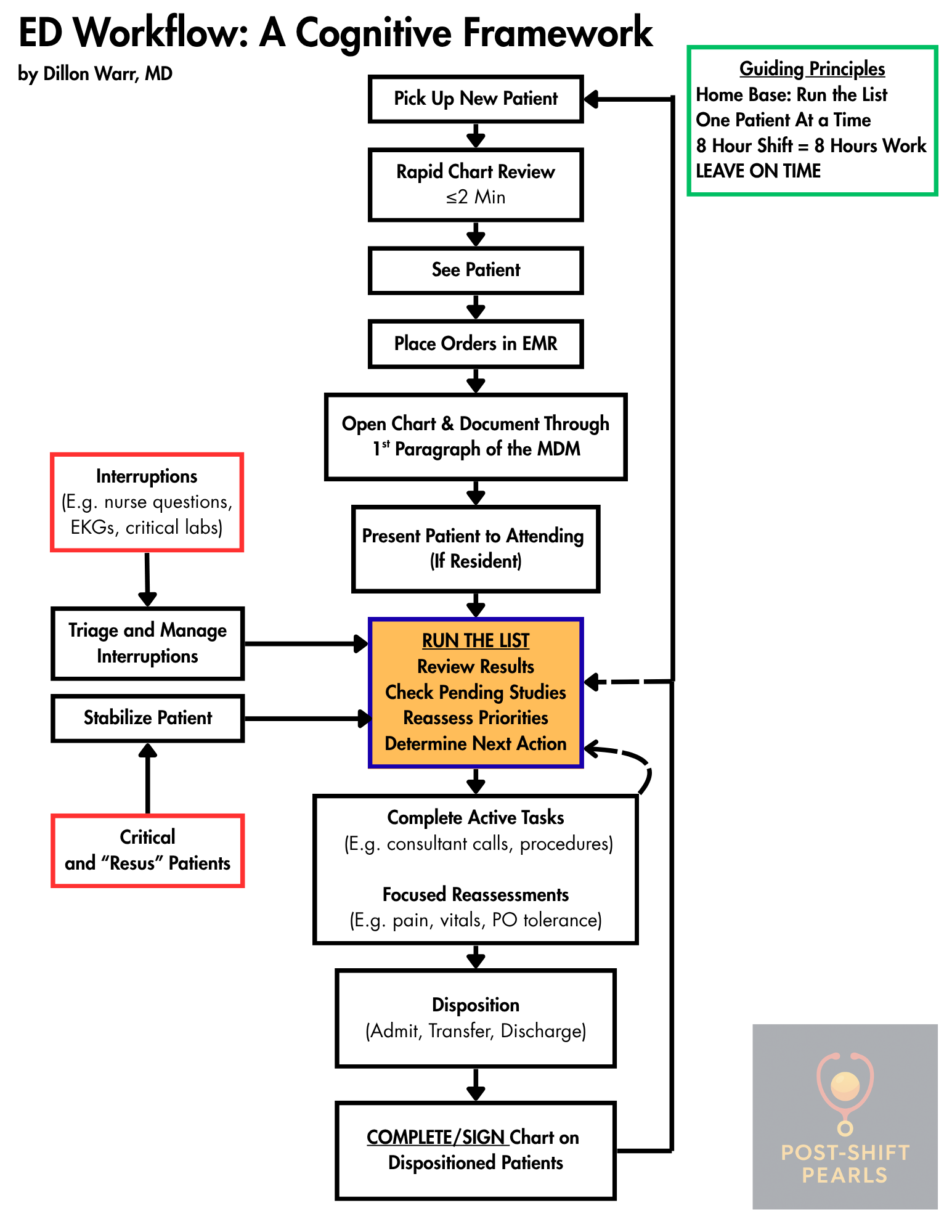
Principle 1: See one new patient at a time.
You can't actually multitask. Cognitive science is clear: true multitasking, performing two tasks simultaneously, is only possible for highly automatic behaviors. What we call "multitasking" in the ED is actually rapid task switching, and every switch carries a cognitive cost. For example, emergency physicians who are interrupted or task-switch during prescribing have nearly three times the error rate compared with uninterrupted work. Our working memory capacity protects us from errors, but it is finite and degrades with fatigue, poor sleep, and the cumulative switching load of a busy shift.[1,2].
After picking up a patient, perform a rapid chart review. The goal isn't to solve the case before walking into the room. Spend no more than one to two minutes reviewing the chief complaint, triage note, vital signs, and any immediately relevant prior records. Then go see the patient.
After evaluating the patient, place your initial orders and document through the first paragraph of your MDM while the story is still fresh. Documenting early offloads the clinical narrative from working memory onto the chart. Waiting until the end of the shift means relying on memory for patients you saw hours earlier, when recall is less reliable and documentation gaps are more likely.
PITFALL: Trying to be more efficient by seeing multiple patients at a time.
One of the most common traps is seeing several patients before returning to the computer because it feels more efficient. In reality, you're asking your brain to retain multiple histories, physical exams, and clinical decisions simultaneously. The mental effort required to reconstruct those encounters often outweighs any time saved by delaying documentation. Unfortunately, one Canadian review found absent or insufficient documentation in approximately 24% of emergency medicine medico-legal cases, most commonly involving the assessment and investigation portions of the chart.[2,3]
Principle 2: Home Base - Run the List
One of the behaviors most consistently associated with highly efficient emergency physicians is repeatedly running the board: reviewing results, checking pending studies, reassessing priorities, and choosing the next highest-value task. The goal is not to manage ten patients simultaneously. The goal is to repeatedly identify and complete the single highest-value task on your patient list. Whether you've just evaluated a new patient, stabilized a critically ill patient, or finished a chart, the next step is usually the same: run the list.
Importantly, running the list does not always lead to picking up another patient. Often, the highest-value task is advancing the care of someone you already own: calling a consultant, performing a procedure, reassessing pain after analgesia, reviewing repeat vital signs, following up a pending study, or completing a PO challenge. Efficient emergency physicians don't simply accumulate new patients, they deliberately move existing patients toward disposition.
Triage your interruptions. Don’t just absorb them. Emergency physicians experience approximately 8–11 interruptions per hour, and frequent interruptions are associated with reduced situational awareness. This framework provides a structured approach to rapidly determine whether an interruption requires immediate attention, address it if necessary, and then return to your cognitive home base. Likewise, critically ill and resuscitation patients appropriately take precedence, but once they have been stabilized, the workflow returns to the same central loop.
Every cycle through the workflow should move patients closer to disposition. Admissions, discharges, and transfers reduce cognitive load by shrinking your active patient list and allowing you to focus on the patients who remain.
Principle 3: 8 Hour Shift = 8 Hours of Work
Principle 4: LEAVE ON TIME
Finally, complete and sign the chart—then let it go. Every unsigned chart is an open cognitive loop. Even when you're not actively thinking about it, your brain continues tracking it as unfinished work, consuming working memory in the background. Completing and signing charts on dispositioned patients isn't just about billing or compliance—it's about cognitive offloading. Each signed chart closes a mental loop and frees attention for the patients still in front of you. Saving documentation until the end of the shift does the opposite: it accumulates unfinished work, compounds the cognitive burden of the EHR, and forces documentation when decision fatigue is highest and recall is poorest.[1,2,4] This is how you prevent yourself from taking notes home with you. Be good to yourself and to your patients.
RECAP: The guiding principles are simple:
One patient at a time.
Home base: Run the List.
Eight-hour shift = eight hours of work.
Leave on time.
For a deeper dive into the cognitive strategies behind this framework—including pre-shift preparation, managing cognitive load, handling negative emotions during a shift, and the resuscitation mindset—I highly recommend EM Cases Episode 200: How EM Experts Think with Scott Weingart, Reuben Strayer, and Mike Betzner. It expands on many of these same concepts and is one of the best discussions I've heard on how expert emergency physicians think during a shift.
Take a look at the attached framework, and I'd love to hear your thoughts.
– Dillon
References
Can You Multitask? Evidence and Limitations of Task Switching and Multitasking in Emergency Medicine.Skaugset LM, Farrell S, Carney M, et al. Annals of Emergency Medicine. 2016;68(2):189-95. Doi:10.1016/j.annemergmed.2015.10.003.
Task Errors by Emergency Physicians Are Associated With Interruptions, Multitasking, Fatigue and Working Memory Capacity: A Prospective, Direct Observation Study.Westbrook JI, Raban MZ, Walter SR, Douglas H. BMJ Quality & Safety. 2018;27(8):655-663. Doi:10.1136/bmjqs-2017-007333.
Medico-Legal Issues Related to Emergency Physicians' Documentation in Canadian Emergency Departments.Smith JD, Lemay K, Lee S, et al. Cjem. 2023;25(9):768-775. Doi:10.1007/s43678-023-00576-1.
Key High-Efficiency Practices of Emergency Department Providers: A Mixed-Methods Study.Bobb MR, Ahmed A, Van Heukelom P, et al. Academic Emergency Medicine : Official Journal of the Society for Academic Emergency Medicine. 2018;25(7):795-803. Doi:10.1111/acem.13361.
Workflow Disruptions and Provider Situation Awareness in Acute Care: An Observational Study With Emergency Department Physicians and Nurses.Weigl M, Catchpole K, Wehler M, Schneider A. Applied Ergonomics. 2020;88:103155. doi:10.1016/j.apergo.2020.103155.
