
Sinus Node Dysfunction and some other stuff.
Hey Team,
Let's begin with a case:
An 83-year-old woman with no significant past medical history presented to the ED after sudden syncope at the airport. She had no prodrome and regained consciousness immediately. On arrival, she was hemodynamically stable, alert, oriented, and in normal sinus rhythm. During her ED observation, she had four discrete episodes of prolonged sinus pauses — the longest approximately 23 seconds — each resulting in loss of consciousness and a heart rate dropping into the single digits, with near-arrest physiology. Each time, she spontaneously recovered to normal sinus rhythm in the 80s and was conversant between episodes. The episodes appeared to be escalating in frequency, occurring roughly 30–40 minutes apart. No reversible cause was identified.
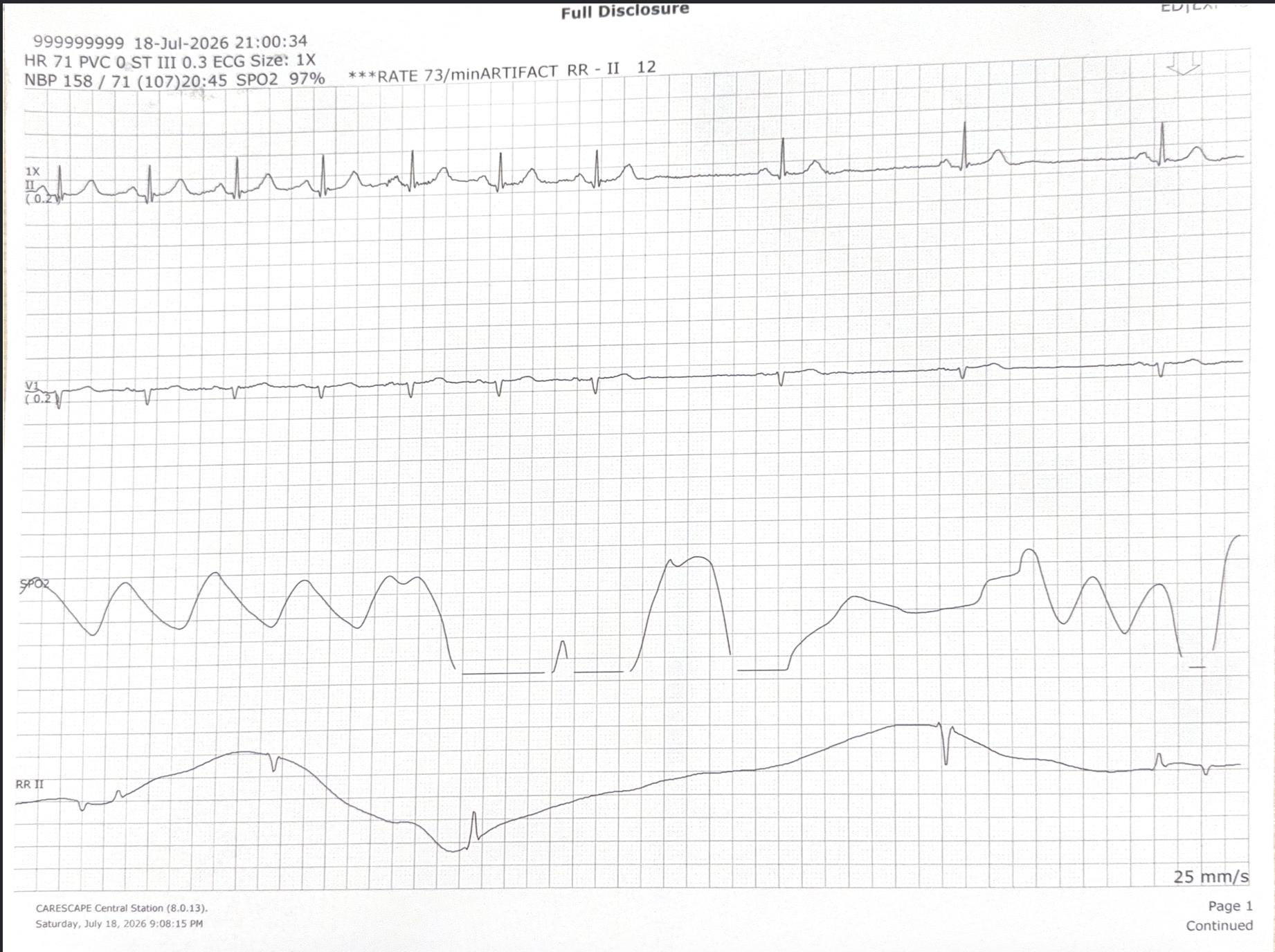
Telemetry Part 1
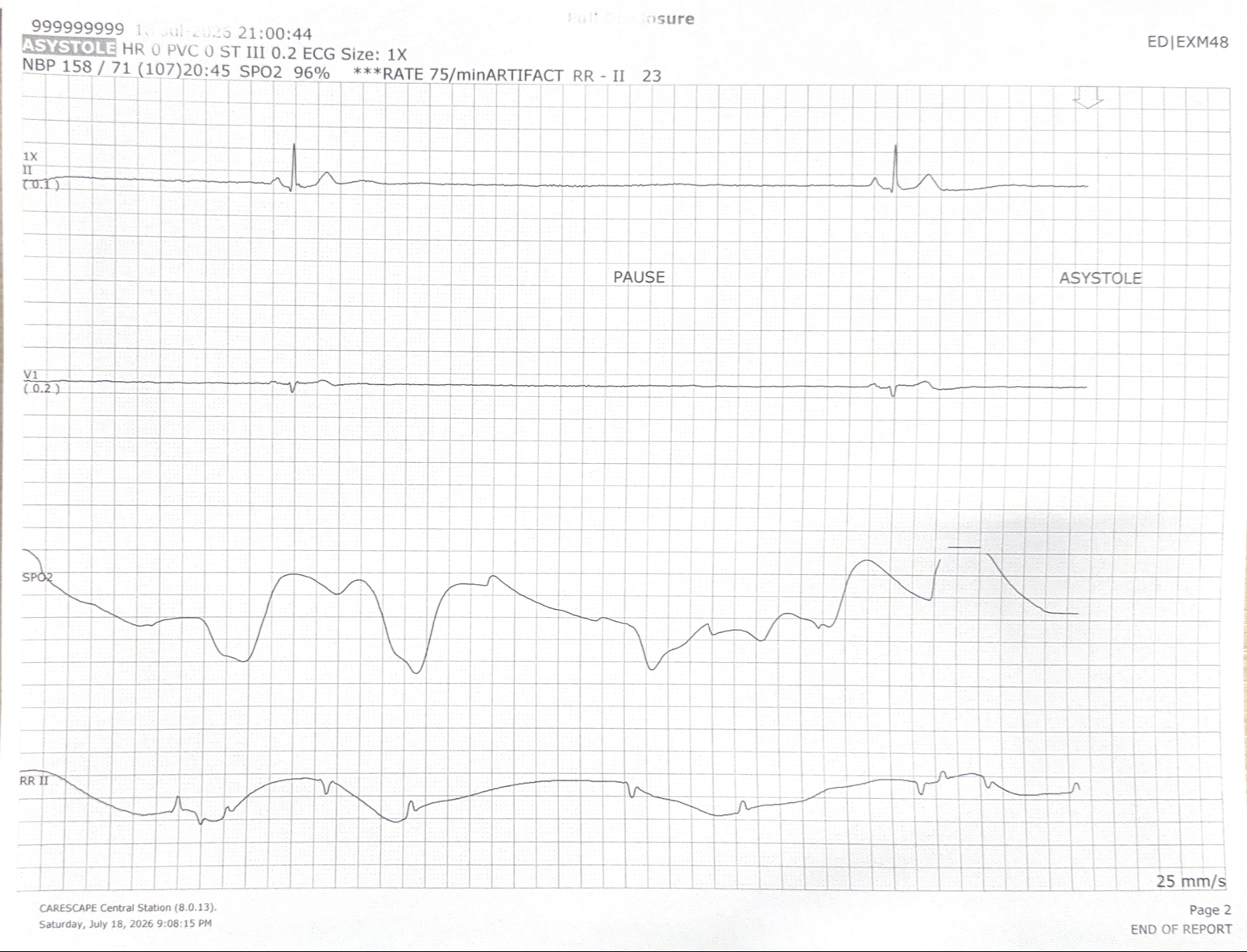
Telemetry Part 2
Relevant Guideline:
The 2018 ACC/AHA/HRS Guideline on Bradycardia and Cardiac Conduction Delay provides a framework
Sinus node dysfunction (SND) is defined by sinus bradycardia <50 bpm and/or sinus pauses >3 seconds, though these findings alone are insufficient for diagnosis. Symptoms must be correlated with the rhythm disturbance.
The guideline describes the "gold standard" for diagnosing SND requiring permanent pacing as direct temporal correlation between symptoms and documented bradycardia or pauses.
Prolonged sinus pauses are described as "debilitating and associated with significant morbidity because of recurrent presyncope or syncope of sudden and unpredictable onset".
Regarding temporary pacing, the guideline states that temporary transvenous pacing for SND is "uncommon, because the risk of acute adverse cardiovascular events attributable to SND is low." However, it is considered reasonable (Class IIa) "in patients with persistent hemodynamically unstable SND refractory to medical therapy... to increase heart rate and improve symptoms until a PPM is placed or the bradycardia resolves".
Notably, the guideline also states that SND is generally "not a life-threatening condition" and that the benefit of permanent pacing is "essentially symptom relief and quality of life improvement"
This characterization that applies to typical SND presentations but is difficult to reconcile with a patient experiencing 15-second pauses and recurrent near-arrest. There is not much guidance for a specific case like this.
Case Resolution: After the fourth episode of prolonged asystolic pause with loss of consciousness, the decision was made to place an emergent transvenous pacemaker in the ED as a bridge to permanent pacemaker implantation. The patient was subsequently admitted for permanent pacemaker placement.
This case is a reminder that while SND is typically considered benign, the extreme end of the spectrum, with prolonged pauses, absent escape rhythms, and escalating frequency, can present as a true ED emergency requiring emergent pacing.
For more on this, see this review on TVP placement in JEM from 2024 and/or this EMRAP video.
Some other stuff from this weekend
Syncope and PE
The PESIT trial (NEJM 2016) reported a strikingly high prevalence of 17.3% among 560 patients hospitalized for a first syncope episode. This scared the crap out of everyone obviously and has left a lingering anxiety about PE and syncope.
However, this finding has been widely questioned, with these findings attributed to possible overdiagnosis from systematic imaging (including detection of subsegmental PE of uncertain clinical significance), false-positive imaging results, and selection bias from enrolling only hospitalized patients
Other studies have since shown that PE is identified in less than 1% of all patients with syncope and in less than 3% of hospitalized patients with syncope.
Although PE should be considered in every patient, not all patients should undergo evaluation for PE. Routine screening for PE in all syncope patients is not warranted. Instead, it requires a targeted approach. Assess for VTE risk factors and PE-suggestive features (dyspnea, tachycardia, hypotension, DVT signs), followed by risk stratification (e.g. Geneva, Wells) and D-dimer testing when clinical suspicion exists.
2. Isotonic Bicarb in Hyperk
In addition to your usual HyperK cocktail, in those with hypovolemia and metabolic acidosis, consider isotonic bicarb as your resuscitative fluid. See EMCRIT for more.
3. Cellulitis
Current paradigm by the IDSA is purulent vs non-purulent cellulitis.
If you have an abscess, I&D it, and send with MRSA coverage (e.g. Bactrim). RCTs have shown that cure rate for SSTIs is higher when treating abscesses with antibiotics after I&D.
If you don't have an abscess, treat for strep/MSSA with a beta-lactam like cephalexin.
A systematic review from 2017 supports TMP-SMX use for purulent cellulitis without an additional β-lactam agent. You do not need to send with "Bactrim + Keflex".
Cheers,
Dillon
